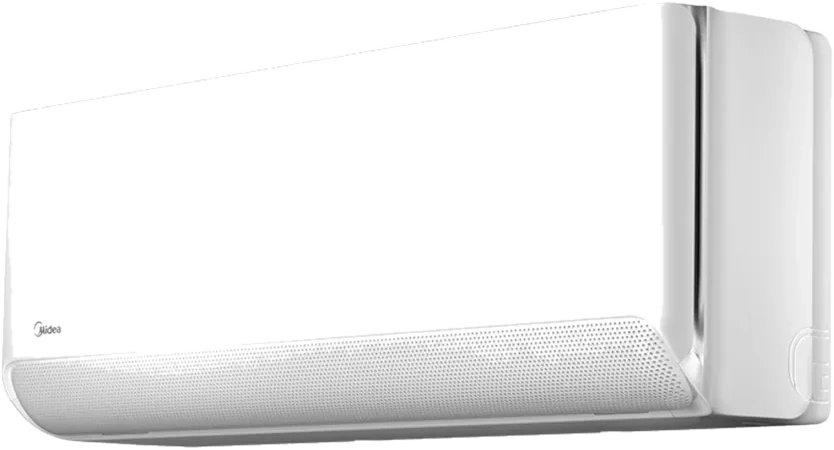
Why a fan is worth trying first.
UK health guidance says an electric fan works well below 35°C, as long as you do not aim it straight at yourself, since that just dries you out rather than cooling you down. Below that temperature a fan is cheap, quick, and often genuinely enough. Above it, or in a bedroom that will not drop overnight no matter what you try, most people start looking at a portable air conditioner next, and that is where this gets more complicated.
The problem no portable can get around.
A single hose portable cools a room by drawing air from inside it, passing that air over a hot condenser coil, and blowing the heat out through a duct fed out of a window. The room has just lost that air and needs to replace it from somewhere, and that somewhere is warm outdoor air, pulled in around the window kit, under the door, and through every other gap in the room. It is like the unit is having a full on row with itself: it is cooling the room and re-heating it at the same time, and it never fully wins that argument.
This is not an installer's opinion about a rival product. The energy labelling regulation that governs these appliances defines a single duct unit in exactly these terms: one whose intake air is drawn from the space containing it and discharged outside that space. The law describes the flaw in its own definition of the product.
What the law actually asks of each one.
Every split system sold in the UK has to clear a legal minimum seasonal efficiency of SEER 4.6. A single duct portable only has to clear an EER of 2.6. At the very top of the scale, an A+++ split has to reach a SEER of 8.50, while an A+++ portable only needs an EER of 4.10. It's tempting to put those numbers side by side and call a split more than twice as efficient, but SEER and EER are not the same measurement. EER is a snapshot, the unit's efficiency at one fixed test condition. SEER is seasonal, averaged across a whole range of real conditions over a real year. What is fair to say is this: the regulator sets a much lower bar for a portable than for a split, and that two tier system exists because a portable is a fundamentally less efficient way to cool a room.
There is a second, quieter reason a split runs more efficiently, and it has nothing to do with the hose. Most portables are fixed speed: the compressor is either fully on or fully off, cycling between the two to hold a room at temperature, and losing a little efficiency every time it switches. The same 2012 regulation accounts for this directly, requiring manufacturers to measure what it calls the effects of the degradation of the energy efficiency caused by on/off cycling. A modern split runs an inverter driven compressor instead, varying its speed rather than switching off entirely. CIBSE's own technical journal puts the engineering case plainly: operating the compressor at low output gives a far more satisfactory system response than frequently cycling the compressor on and off.
What it actually costs to run.
None of that is abstract once you look at a bill. The Energy Saving Trust puts the cost of running a portable at £4.62 to £5 for a 24 hour day, up to 20 times more than running a fan. That is built on the Ofgem price cap of 26.11p per kWh, the rate in place from July to September 2026.
Energy Saving Trust, cost to run for a 24 hour day, GB average.
A fitted split, sized properly for the room and running on an inverter, costs a fraction of that to hold the same room at the same temperature, because it is not fighting warm air coming back in and it is not losing efficiency every time it cycles. We have worked through what a fitted system actually costs to run on your own tariff separately, with a calculator that uses your own numbers rather than an average.
The one thing it does not do in January.
There is another point too, subtle but important: the portable you picked up in a retail park cools a room and does nothing else. A fitted split is a heat pump running in reverse, and the same unit that cools the back bedroom in July takes the chill off it in January. A portable spends most of the year in a cupboard. A fitted split earns its keep in both directions.
Where a portable is genuinely the right call.
None of this makes a portable the wrong answer for every situation. If you are renting and cannot fix anything to a wall, which comes up often in flats across Cardiff and the bigger towns, if you need to cool one room for a single short heatwave and then never again, or if you are simply not ready to commit to a fitted system yet, a portable is a reasonable, honest choice.
A dual hose portable is a genuine step up if a portable is what you need. It draws its intake air from outside rather than from the room, so it is not feeding on the air it just cooled. It is still noisier indoors than anything on the wall, it still takes up floor space and a window, and it still will not heat the room in winter, but it is a fair improvement on a single hose unit.
What a fitted split actually costs, in case that is what is stopping you.
The reason most people default to a portable is price, and it is worth checking that assumption before you buy one. A single fitted unit in a typical South Wales terrace starts at £1,925, spread interest free over 12 months, or £1,500 paid in full, and that includes the survey, the fitting and the electrical work. We have broken down exactly what that figure includes if you want the full picture. Set against a season or two of running a portable at £4.62 to £5 a day, on top of the £250 or £300 it cost to buy in the first place, the gap is smaller than it looks from a shop shelf. You can price your own room in about two minutes rather than guessing at it.
The part that never comes up in a shop.
One more difference is worth knowing, even though nobody mentions it on the shelf. UK law requires anyone who installs or services equipment like the split on your wall to hold F-Gas certification, because it is the kind of equipment a person can open up and work on. A portable arrives from the factory with its refrigerant already sealed inside, gets plugged in by whoever bought it, and nothing about buying one puts it in front of a certified engineer, because nothing about it needs to. That is not a mark against portables, they are built to be used exactly that way, but it is a genuine difference in how much oversight each product gets over its lifetime, and it is part of what you are paying for with a fitted system.