Cool in the summer. Warm in the winter.
One team, from the first survey to the yearly service. You're not passed between a fitter and a separate sparky, and we don't leave you until your unit is fitted, plugged in and working.
The people who quote your job are the people who fit it: the unit, the wiring and the yearly service. No subcontractors, no separate electrician's bill, and only one number to call if you ever need us.
We come out for about fifteen minutes, measure up, check the electrics and give you a fixed price in writing. There's nothing to pay whether you go ahead or not.
We fit, wire and commission in one visit, and we don't pack up until it's running and the room is cooling. If something isn't right, we stay and put it right.
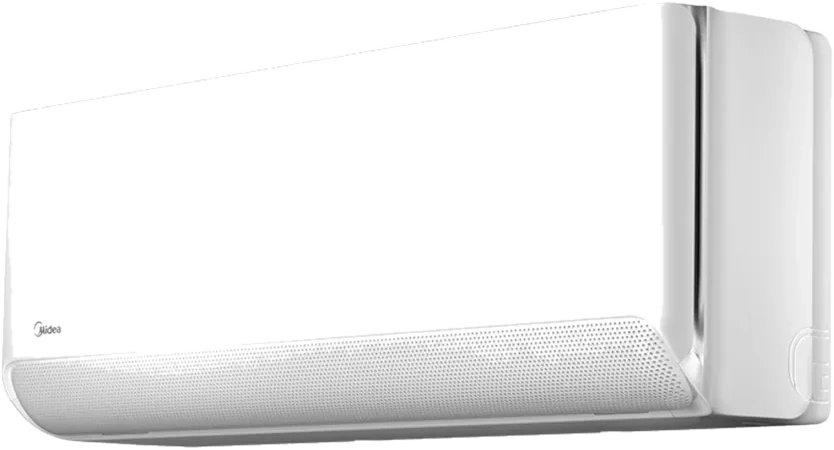
Every price here is for the Midea Breezeless E: A+++ rated, 17.5 dB(A) on its lowest setting, and 199mm deep so it sits close to the wall.
We cover South Wales and the Bristol side, within about an hour of us, and we only do homes, so yours is never squeezed in around a shop fit. If you need us again, we're just up the road.
You're covered for 10 years, and your first yearly service is included. The only two conditions are that we register it with the manufacturer, and it gets serviced once a year.
A room costs £1,700 to do, and that's the number most people have in their head when they start working it out. Very few end up paying it, because these four discounts come off the whole job and they stack on top of each other.
This is the big one, and it's worth more than the other three put together. On a three room job it comes to £1,173.
Every extra room takes another 4% off the whole job, not just off that room, up to 20% in total.
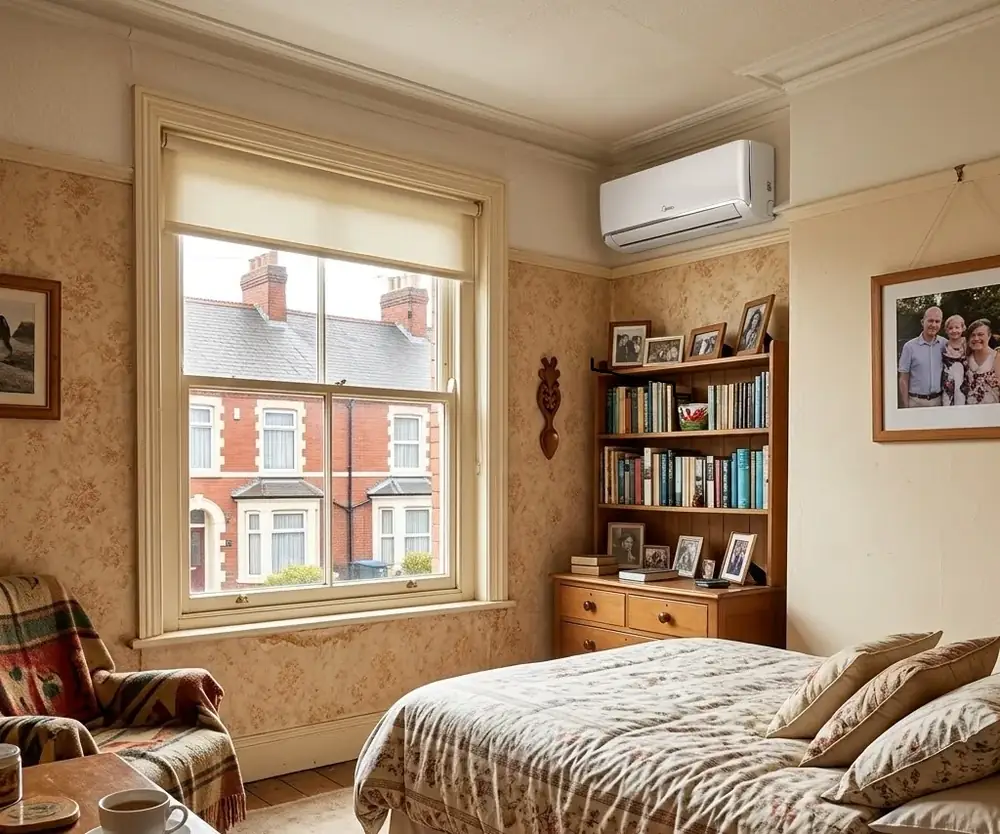
Nobody sleeps well in a warm room, and least of all a little one.
The people who feel the heat most shouldn't have to pay the most to keep comfortable.
Here's what that looks like on a three room job, with the multi-room discount already applied.
The discounts come off the installation itself. If your fuse board needs upgrading that's £750 and we don't discount it, because there's very little in it for us once the parts and the certified labour are paid for. Every figure here is an estimate until we've surveyed your house.
And what does the price actually pay for? The unit itself, the pipework and trunking out to the outdoor unit, the electrical work, the refrigerant and a full day of our engineers' time, then the commissioning, the 10 year guarantee and your first service. When we survey your home we're measuring exactly those things, which is why the estimate you build here and the final written quote stay close.
Unbearable outside. 17°C where you sleep.
You get quiet, filtered air, room by room, whenever the heat comes. It takes the moisture out too, so the house feels fresher, not just cooler.
The same unit works the other way round in winter. For every £1 of electricity it puts out around £4.60 of heat, and it keeps working down to −20°C outside.
It's the Midea Breezeless E: slim and stylish, with a simple remote control, voice control through Alexa and Google Assistant, and an app on your phone so you can get the house ready before you get home.

This is it closed, flush to the wall. At 199mm deep it sits close in.
A mouse's squeak is around 30 dB. On its lowest setting, most people can't even hear it running.
SEER 8.5 for cooling, SCOP 4.6 for heating. Roughly £4.60 of heat for every £1 of electricity.
It's 812mm wide, 299mm tall and 199mm deep. That's about the size of a bathroom cabinet, and a lot flatter.
Figures are manufacturer data for the 2.6 kW Breezeless E, the size we'd typically fit to a bedroom. Larger rooms take a larger unit. We'll tell you which one you need at the survey.
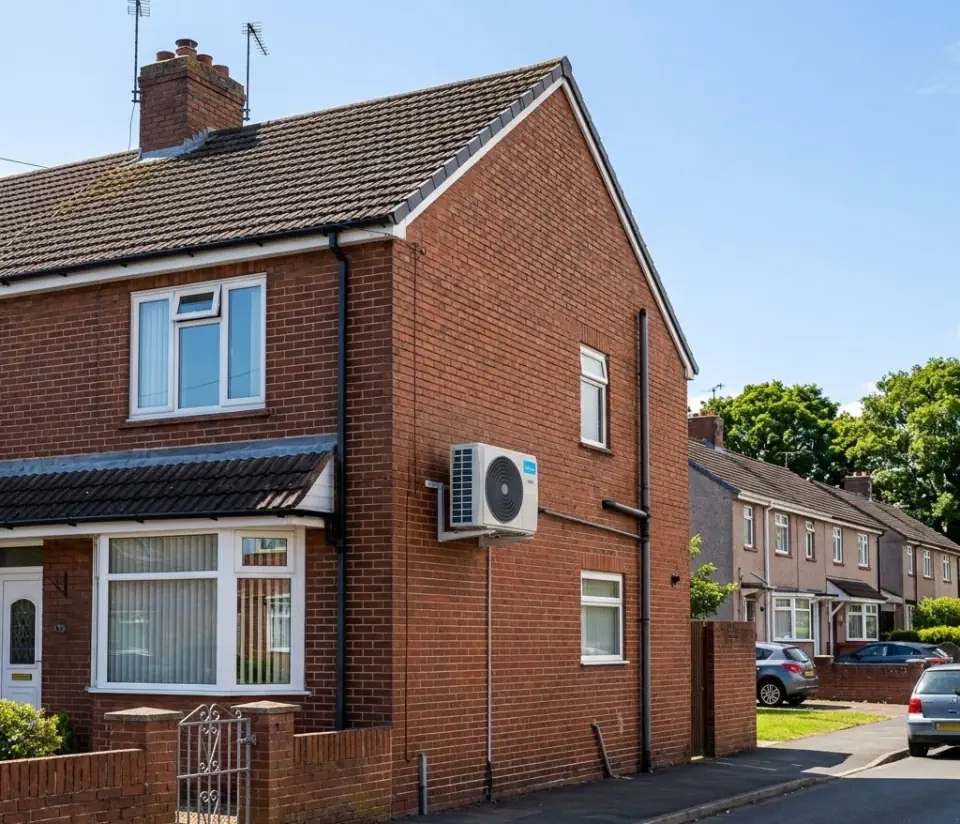
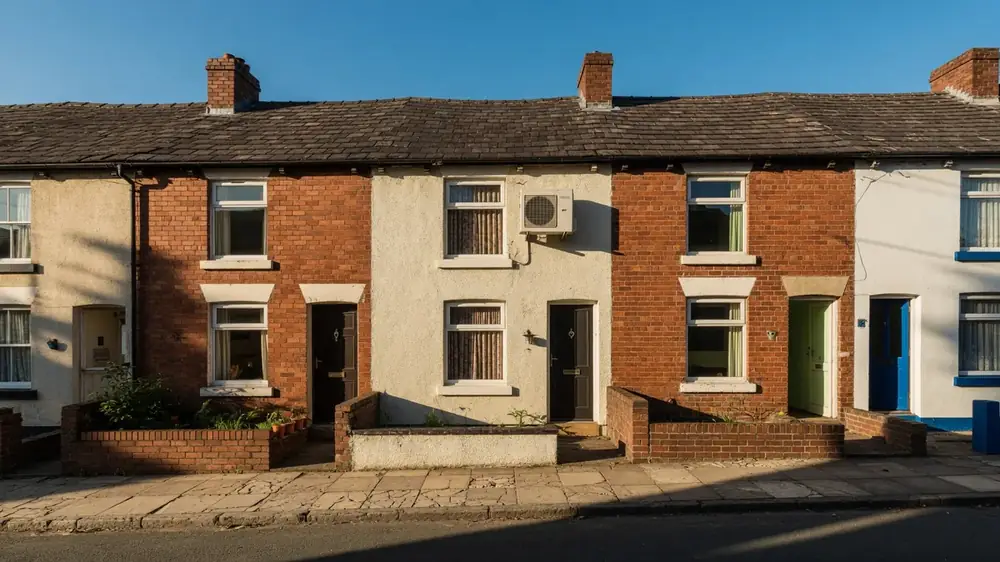
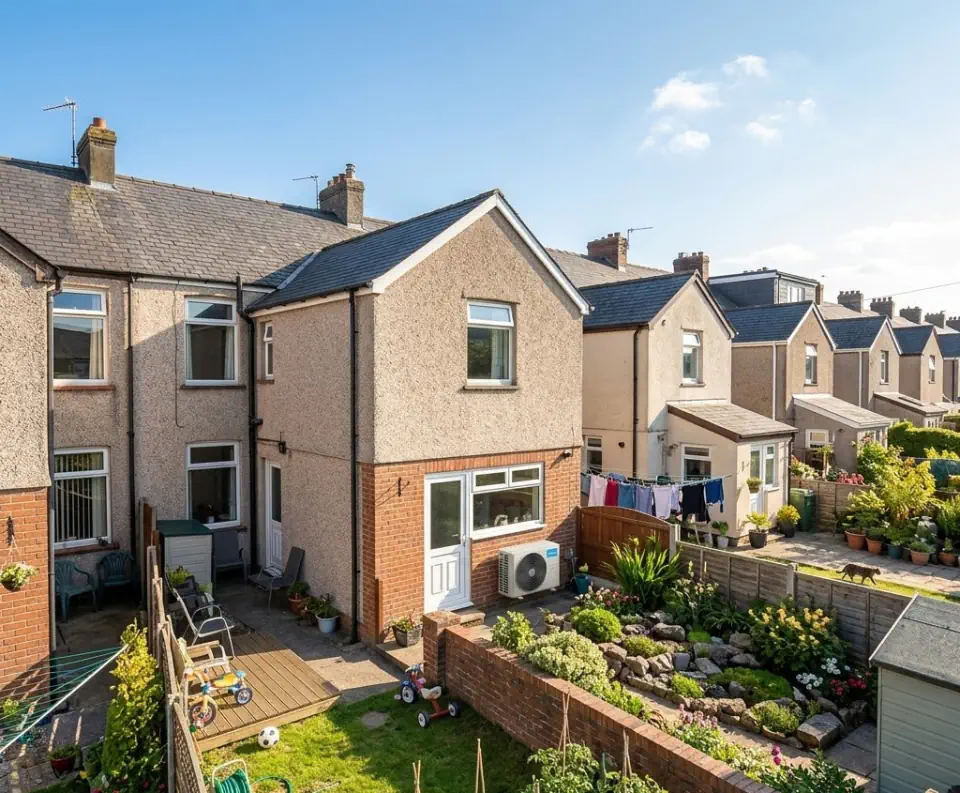
Fair enough, and you usually don't have to have it there. On most South Wales housing there's more than one option, and we'll walk round with you before anything is decided.
The best option on an end terrace or a semi. It's out of sight from the street and the pipework runs straight through into the room behind.
On a mid-terrace with no side access this is often the honest answer. Mounted high and central, it reads as part of the building rather than an add-on.
If you've got a back garden, this is usually where it ends up. Nobody sees it but you, it's easy to get at for servicing, and it just needs a bit of clear space around it to breathe.
In a heatwave, a cool home does more than help you sleep. The research is fairly clear on who feels the benefit the most, and why keeping the temperature down really matters.
Heatwaves push up hospital admissions for heart attacks and stroke. Keeping the house cool eases the strain that extreme heat puts on the heart.
Most heat-related deaths are among the over 65s, and there's no cool public building to escape to at two in the morning. Cooling at home is the safeguard that's always there.
Babies can't cool themselves down, and warmer nights raise the risk. A steady room temperature takes the indoor heat stress away.
A UV lamp plus HEPA and cold-catalyst filters clear pollen, dust and fine particles, which can help with asthma and hay fever. It only works if it's kept serviced, mind.
South Wales summers aren't what they were. Terraces, valley homes and new-builds are designed to hold heat in: a blessing in January, an oven by July. We fit systems that do the opposite: cool, filtered, quiet air, room by room, whenever you need it.
And the people who feel the heat worst: older relatives, young children, anyone who can't sleep when the bedroom won't drop below 25°. They're the ones who feel the difference first. That's who this is really for.
If yours isn't here, just ring us or drop us a message.
Usually not. A domestic air conditioning unit is normally permitted development in Wales, so no application is needed.
The exceptions worth checking: listed buildings, conservation areas, and units on the principal elevation facing a highway. There are also size and siting limits, and flats are treated differently to houses. If any of that might apply, tell us at the survey and we'll check with the council before you commit to anything.
Indoors, the smallest unit runs at 17.5 dB(A) on its lowest setting. For comparison, a quiet library is about 30 dB. Most people genuinely cannot hear it once they stop listening for it.
The outdoor unit is louder, around 55 dB(A), which is roughly a fridge or a quiet conversation. It's worth thinking about where it sits in relation to your neighbour's windows as well as your own, and we'll raise that at the survey rather than leave you to find out later.
Yes. It's a heat pump, and it's rated to keep producing heat down to −20°C outside. Cwmbran rarely drops below −5°C, so it's working well within itself even in a cold snap.
It heats room by room rather than the whole house at once, which suits some homes and not others. If you've got a working boiler, most people use it alongside rather than instead of, at least at first.
Usually one day for a single room, and most multi-room jobs are done in two. We'll give you a firm answer after the survey, because pipe runs are what drive the time and every house is different.
We turn up when we say we will, and we clear up after ourselves.
There's one core hole per room, about 65mm across, drilled through to the outside. It's done with a core drill and a vacuum, so it's a lot tidier than people expect. The hole is sleeved and sealed both sides.
Pipework outside is run in trunking, and we'll agree the route with you before we start rather than after.
Our lot leave a place exactly as they found it. Often a bit tidier, if we're honest.
Parts and labour on the equipment we install, backed by the manufacturer's warranty and our own workmanship guarantee.
It's conditional on the system being serviced annually, which is standard across the industry and is also just how you keep the thing working properly. We'll remind you when it's due.
That's most of south Wales, from Swansea to the Valleys, and a good way over the bridge into England. If you're not sure whether you're in, ring us and ask. The survey is free either way.
A lot of people assume air conditioning costs a fortune to run. It doesn't. Put in your own energy tariff and see the real figure, next to a gas boiler or a plug-in fan.
Build a price in a couple of minutes, or skip it and have a chat with us instead. No pressure either way.